
Fall armyworm research, development and extension for horticulture
Latest news and updates
-

Webinar highlights and video link: push-pull system for sustainable fall armyworm control in Africa
Queensland Department of Agriculture and Fisheries (DAF) extension officer Dr Ramesh Puri, hosted the webinar ‘Integrated Pest Management for fall armyworm: Experiences from Africa’ on 18 July, in collaboration with the International Centre of Insect Physiology and Ecology (icipe) in Kenya. Thirty-five researchers and extension officers from across Australia participated in the event, which was delivered by the Hort Innovation co-funded fall armyworm extension project. The webinar was part of a series of project events aimed at bringing the latest fall armyworm research from across the globe to Australian audiences.
Scientists from icipe, Dr Sevgan Subramanian and Dr Amanuel Tamiru provided valuable insights into fall armyworm Integrated Pest Management (IPM) strategies and the push-pull agroecological farming system. Dr Sevgan, presented sustainable solutions for fall armyworm management by smallholders in Africa, detailing effective strategies and advancements in monitoring and managing this pest (Image 1). Dr Tamiru followed with a discussion on the chemical ecology mechanisms underpinning the push-pull system, a groundbreaking approach to combating invasive pests like the fall armyworm (Image 2).
Key messages from the webinar presentations and discussion:
- There is a need to understand fall armyworm's migratory or resident nature in new invasion zones such as Africa and Australia. This is critical for fine-tuning fall armyworm management strategies.
- Maize grown in a diversified cropping system such as maize-legume intercropping or push-pull systems, is more resistant to fall armyworm than maize grown in a monocrop system. There is an opportunity to adapt diversified maize cropping systems to different scales of maize production (from small to large-scale production).
- New associations of fall armyworm with parasitoids of other widely prevalent armyworms have been commonly observed in new invasion regions in Africa and Asia. These new associations of fall armyworm with locally prevalent parasitoids and predators need to be documented to support their conservation and augmentation.
- Similarly, biopesticides such as Metarhizium anisopliae and baculoviruses effectively manage fall armyworm if integrated with other IPM strategies. These biopesticides are commercially produced, and their efficacy is tested in the field. However, their adoption rates are low due to higher costs in Africa. Efforts to build capacity for localised production are ongoing.
- Push-pull is an agroecological farming system that exploits natural insect-plant and plant-plant interactions to manage crop pests. Some farmers use pesticides in the push-pull systems; however, many do not.
- Bioactive volatiles from push-pull companion crops mediate reduced pest infestation by repelling crop pests (FAW, stem borers), inhibiting parasitic weeds such as Striga through root exudates, and attracting their natural enemies (parasitoids, predators).
- Combining agroecological approaches and biocontrol options could provide sustainable and affordable solutions to manage maize pests such as FAW and stem borer.
- Combining agroecological approaches and biocontrol options could provide sustainable and affordable solutions to manage maize pests such as FAW and stem borer.
Click for the Q&A session
The webinar was delivered as part of the Hort Innovation funded project VG22006, 'National Fall Armyworm (FAW) Innovation System for the Australian Vegetable Industry'.
FAW moth catches from pheromone traps
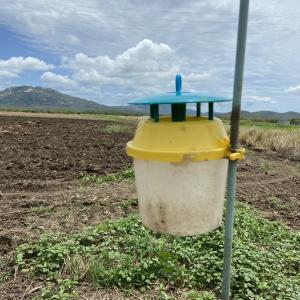
Bowen (North Queensland) FAW moth catches

Gatton (South East Queensland) FAW moth catches
Updated: 18 August 2026
Various peak values have been recorded, most of which occur during the warm-weather season. Since the initiation of the trapping program, the highest number of male moths collected on traps was between January and February 2024.
Weekly moths catch: 0 / week
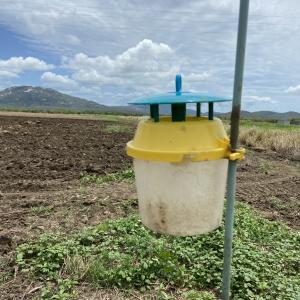
Tenthill (South East Queensland) FAW moth catches
Updated: 18 August 2026
A pheromone trap baited with Pherolure was deployed at Tenthill in February 2025 during the sweet corn growing season.
Weekly moths catch: 19 / week